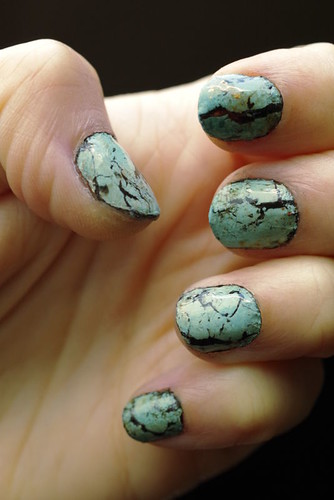
 I had never considered combining polymer approaches with nail art, because of the treacherous incompatibility on the long term between many nail polish and polymer clay. I don't care much for cutesy cane slices on nails. But then I saw the beautiful false nails Claire Wallis made (found them through an "Other things you might like" link in The Polymer Arts blog), and started to think about what polymer clay could be used for in nail art. I am at best a dabbler in nail art, and I can neither reach Claire Wallis's wonderful precision in caning, nor draw correctly, especially on such a small surface.
jeudi 25 septembre 2014
Playing with polymer clay techniques - without polymer clay-
I had never considered combining polymer approaches with nail art, because of the treacherous incompatibility on the long term between many nail polish and polymer clay. I don't care much for cutesy cane slices on nails. But then I saw the beautiful false nails Claire Wallis made (found them through an "Other things you might like" link in The Polymer Arts blog), and started to think about what polymer clay could be used for in nail art. I am at best a dabbler in nail art, and I can neither reach Claire Wallis's wonderful precision in caning, nor draw correctly, especially on such a small surface.
dimanche 21 septembre 2014
Hollow beads using water-soluble child's clay
Among all the uses of playdoh encased in polymer clay, making hollow structures is a very interesting one, although somewhat tricky. There have been many uses of various water-soluble products for this purpose (like sugar for instance), and I am pretty sure others have tried this too.
It is probably not the best material but can come in handy, and allows to make very nice custom shapes.
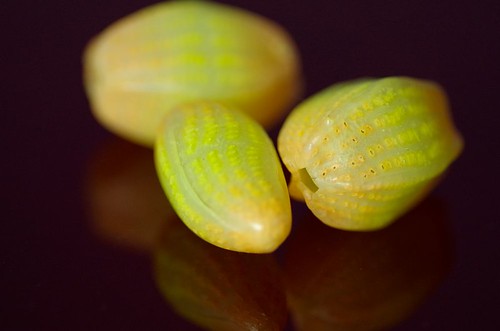
It is probably not the best material but can come in handy, and allows to make very nice custom shapes.
samedi 20 septembre 2014
Shell beads
Water-soluble clay lends itself very well to make very easily complex-shaped hollow beads. These shell beads are based on the playdoh cane and completely hollow, although I think some playdoh remains in the inner spires, and give them those nice pink shades.
The bead is basically a bull's eye cane with a fine outer layer of polymer clay and a larger playdoh core that has been rolled into a cone and then unto itself.
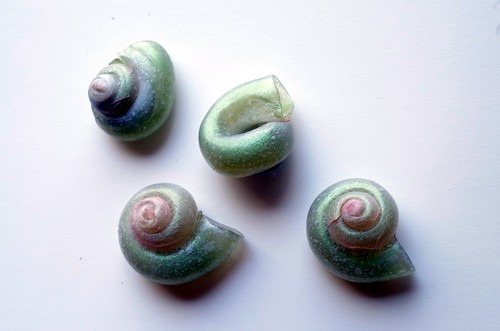
The bead is basically a bull's eye cane with a fine outer layer of polymer clay and a larger playdoh core that has been rolled into a cone and then unto itself.
The playdoh faux wood cane
This cane is a very easy variation of the playdoh cane, and makes a wood surface with a lot of texture. The texture is naturally aligned with the (faux) wood grain, and is great for all antiquing techniques.
This works great with molds:
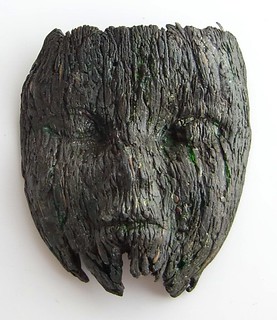
As a surface texture for faux wood (adapted from the twig tutorial of Randee M. Ketzel)
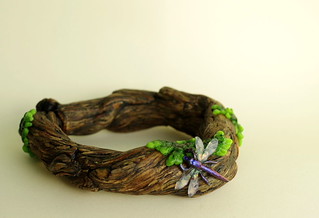
This works great with molds:
As a surface texture for faux wood (adapted from the twig tutorial of Randee M. Ketzel)
The playdoh cane
Two years back, I experimented a lot during the fantastic "Becoming a better artist" course of Christine Dumont on Voila!. One of these had a huge potential, and many applications: the playdoh cane.
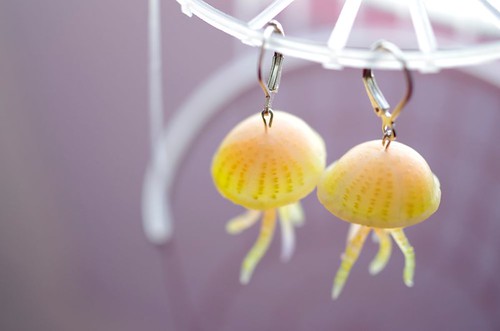
These jellyfish have pinhole sized-holes all around:
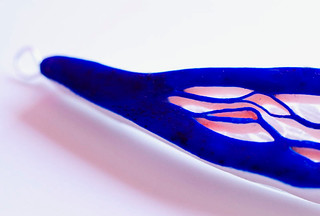
This is a variation of the Stroppel cane. The internal walls are about half a millimeter thick:
These jellyfish have pinhole sized-holes all around:
This is a variation of the Stroppel cane. The internal walls are about half a millimeter thick:
Starting again ?
After forever, a reboot of this blog...
I had been relatively active in between here.

I can't promise this will be regular, or anything, but I want to group older and new polymer work and tutorials under a more cohesive (and more easily findable) structure than my photo streams. Hope it will be of help...
Je n'ai pas trop le temps de tout faire en bilingue français-anglais, mais s'il y a assez de demandes, je m'y mettrais...
I had been relatively active in between here.
I can't promise this will be regular, or anything, but I want to group older and new polymer work and tutorials under a more cohesive (and more easily findable) structure than my photo streams. Hope it will be of help...
Je n'ai pas trop le temps de tout faire en bilingue français-anglais, mais s'il y a assez de demandes, je m'y mettrais...
mercredi 30 novembre 2011
Noir et blanc
 Hexacorallia in black and white
Un collier terminé in extremis pour le challenge noir et blanc sur Parole de Pate. Kato polyclay en blanc et noir gravée d'après des transferts de dessins anciens adaptés, trouvés sur le site de l'Educational Technology Clearinghouse de Floride, peinture acrylique noire. Je ferais un bref tuto quand j'aurais le temps (pas tout de suite, donc).
A necklace I finished minutes ago for the black and white challenge on Parole de Pate.
Kato polyclay in black and white, engravings using old drawings adapted from those found on the Florida's Technological Clearinghouse website, black paint. I will explain how I did it when I have time.

Il y eut pas mal de casse dans l'opération, et partie d'assez de lentilles pour faire plusieurs colliers, il n'en resta qu'un d'arrivé à bon port.
Un s'est perdu au dernier moment : les lentilles noires et blanches qui devaient être assemblées ne vont manifestement pas (ou plutôt plus) ensemble.
Lots of disks got lost in the process, the ones just above at the very last minute: antiquing transformed them just enough that they would not look good together.

Il reste beaucoup de lentilles, mais le problème est visible sur la photo: elles ont changé de couleur à la cuisson, aussi bien les noires (et translucide) que les blanches, et il n'y a plus de quoi assembler des colliers entiers et assortis. C'est la première fois que cela m'arrive avec la Kato, mais j'ai eu trois couleurs légèrement différentes en trois cuissons, en partant des mêmes paquets...
Inscription à :
Articles (Atom)


